
Where does a Tree get its Mass?
See how 16 classrooms learned and overcame a widely prevalent misconception!


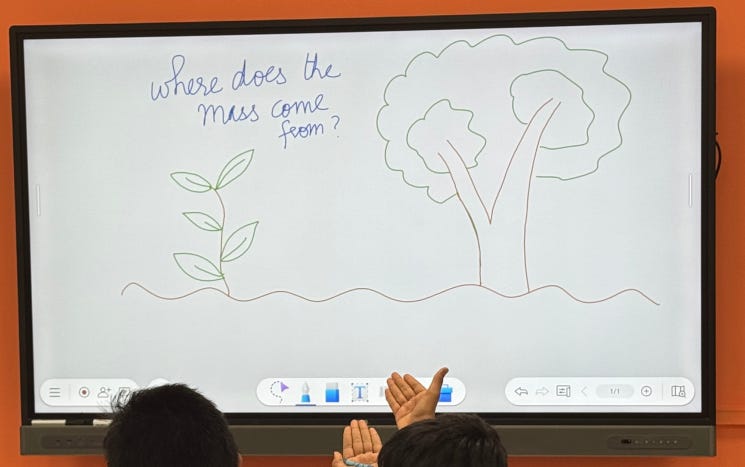
Sixteen teachers across India and Dubai drew a small mango sapling on the board, then a large mango tree beside it. They asked their students: “This small mango sapling weighs less than a kilogram. Over many years, it can grow into a huge tree that weighs thousands of kilograms. Where does all that extra mass (the solid wood, branches, and leaves) come from?”
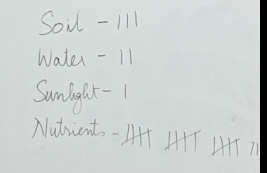
In roughly twelve of the thirteen classrooms that ran this activity, the most popular answer was soil. Nutrients. Fertilizer. In one classroom in Dubai, the whiteboard tally read: Soil -- 3, Water -- 2, Sunlight -- 1, Nutrients -- 17. At a school in Palakkad, Grade 8 students were more blunt: “Plants eat soil.” One student wrote that fertilizer becomes the wood of the tree.
One class was an outlier. A Class 9 teacher in Bengaluru found her students had a different wrong answer: “Sun.” They’d learned the photosynthesis equation and concluded that solar energy was being converted into mass, confusing energy with matter. More on that shortly.
The teachers then revealed an experiment from 1648. Belgian scientist Jan Baptist van Helmont planted a willow tree in a weighed pot of soil, watered it carefully for five years, and measured everything at the end. The tree had gained 75 kilograms. The soil had lost 57 grams.
In a classroom in Pune, the room got quiet on hearing these numbers. In the words of their teacher: “They were forced to think beyond their primary logic.” In a Grade 6 class at another Pune school, the reaction was louder. The question that came to students’ minds: “How is this possible?”
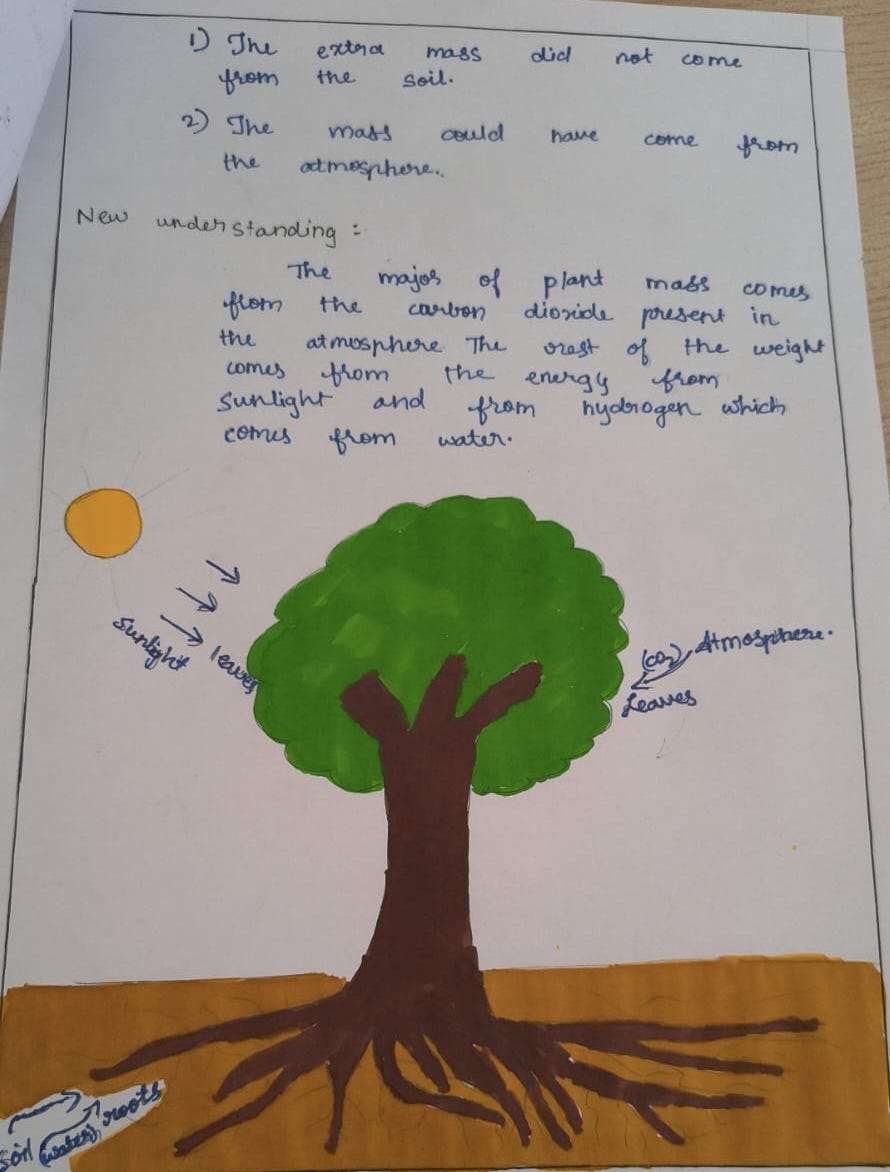
The thing is, most of a tree’s mass comes from the air.
The LEGO bricks
A teacher used this analogy. Think of using LEGO bricks to build a structure. Carbon dioxide from the air provides the carbon and oxygen atoms - the bricks. Water provides hydrogen - more bricks. Sunlight is the power source that snaps the bricks together. It is not itself a brick.
While thinking through this, a student said: “Air has mass because carbon dioxide has carbon atoms.” Another: “The carbon in wood comes from the air.” Her colleague confirmed, noting that “the real thinking process started with the introduction of the LEGO bricks analogy.”
The LPG problem
One Bengaluru classroom hadn’t been confused about soil. Their mistake was subtler: they thought sunlight became wood. The LEGO analogy wouldn’t help because it treats sunlight as “the power source,” which these students already accepted. They needed to hear that energy and matter are different categories before the rest could land.
Their teacher reached for a kitchen analogy. When you cook rice, the LPG gas does not become cooked rice. It provides the energy. The mass of the cooked rice comes from the rice and the water, not from the flame.
Sunlight works the same way. It powers the reaction. It doesn’t become the tree.
Arrows from the sky
Across classrooms, students were asked to draw at start and the end of the class. They had to a tree with arrows showing where the mass comes from. At the start of the lesson, the thickest arrows pointed up from the soil. By the end, they came from the sky. One class arrived at a sentence: “A tree is a tower of solidified air and water, bound together by sunlight.”
In Dubai, a student working through the logic said: “Air feels light but it must add up over time.”
A tangent: the question isn’t new
In several classrooms, the Van Helmont experiment sparked a side conversation. Students found it striking that a scientist in 1648 had asked the same question they just got wrong, and spent five years on a single measurement. Van Helmont himself didn’t get all the way to the right answer either -- he concluded it was water.
Carbon dioxide makes up 0.04% of the atmosphere. That a gas which seems like nothing becomes the solid mass of a tree trunk is a strange fact. The students who said soil were being perfectly reasonable.
This activity didn’t happen by accident. These sixteen teachers are part of My Misconception Mentor (M3), a programme where math and science teachers work with well-researched student misconceptions identified through ASSET, India’s diagnostic assessment. M3 gives teachers the map: here is what students typically get wrong, here is why, and here are the teaching moves that address it. The mango tree question, the Van Helmont data, the LEGO analogy -- these are all part of a structured sequence the teachers adapted for their classrooms.
By the end of these lessons, exit ticket drawings across classrooms had flipped. In Pune, Palakkad, Dubai, Bengaluru, Tumkur, the arrows pointed down from the sky.
If you are interested in My Misconception Mentor, the next edition of this online course starts at the end of June and end of September 2026. To enrol yourself or teachers from your school for the program please reach out to Siddharth on siddharth@genwise.in or +91 87627 03967 or Prakhar on prakhar.ghildyal@ei.study. Interested parents may also enrol themselves in this course.
This is very similar to a child thinking that the picture in the TV flows through the power cord which connects the TV to a power source!
Lovely everyday example and an unexpected answer!
We teach biology but not its surprising aspects.