
Where did the Energy go?
A diving board, a silent classroom, and the slow path to a real answer

A real joy of learning is to start seeing principles of science and math explaining things in your everyday life. In GenWise’s online programs, we focus on building a love for learning that enables children to always engage with their curiosity. This blog documents a question discussed by Dr. Siddharth Bharath as part of a course on “Energy and its Transformations” in our year long Talent Nurturing Program. It is a beautiful reminder that sticking with questions, rather than quickly jumping to answers, leads to much more satisfaction in learning.
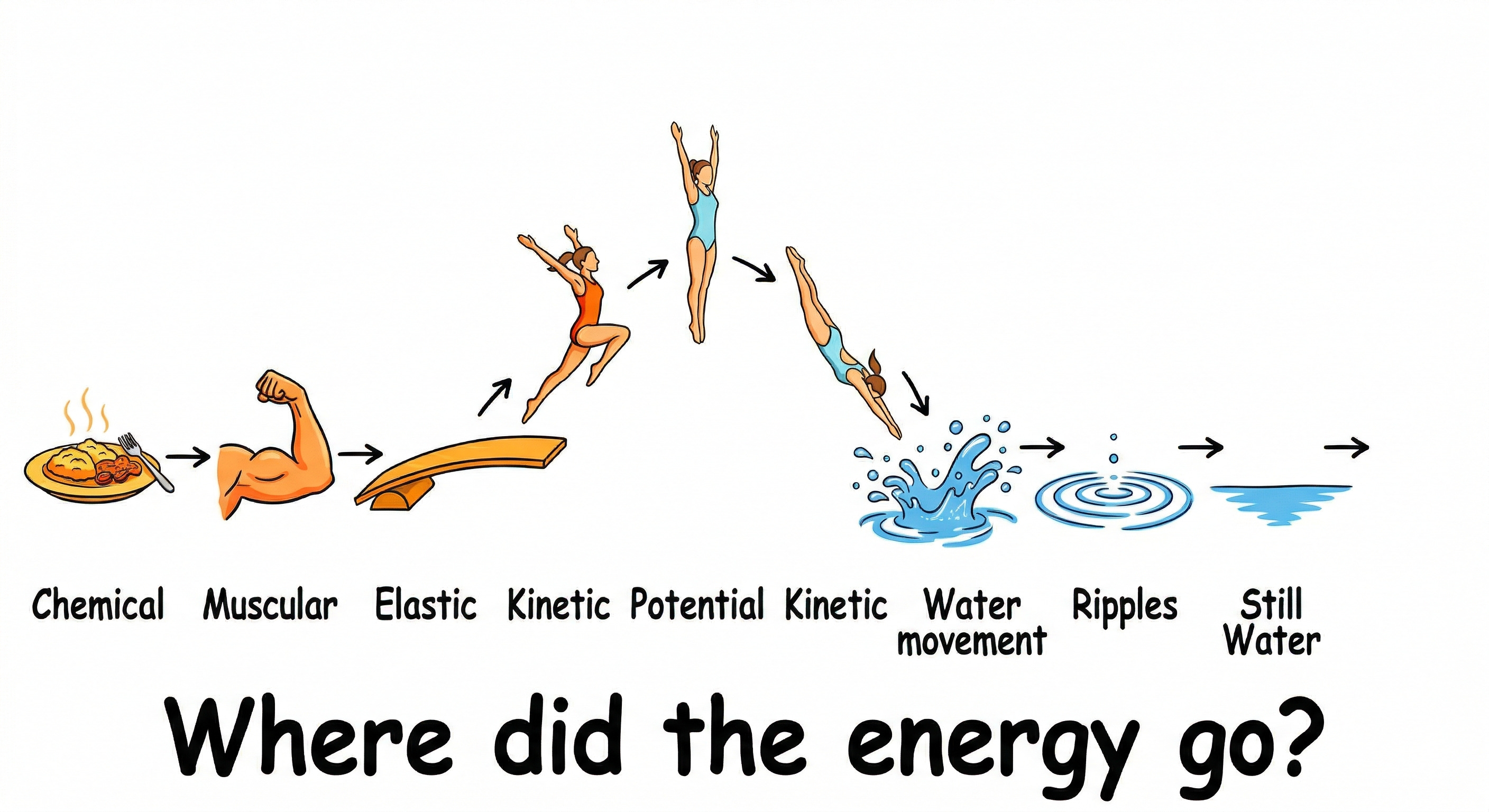
Towards the end of the first session of a course on Energy, Siddharth Bharath drew a stick figure on a diving board and asked ten 12-to-14-year-olds to trace what happens to energy when a diver jumps into a pool.
The students traced the chain with ease. Food becomes muscular energy. Muscles push on the board, the board bends and launches the diver upward. Kinetic energy carries her into the air; at the peak, it’s all potential energy. Then the fall, kinetic energy building, until she hits the water.
Splash. Water flies up, then falls back down. Ripples spread across the pool. Then the ripples stop. The water goes still. The diver floats, motionless.
“The diver had potential energy when she was on the top of the diving board. So, where did all of that energy go by the end?”
Ayansh offered a guess: “I think it’s just the ripples. It just got, you know, diluted over a large area.”
Siddharth pressed. “The ripples also stopped.”
Ayansh tried again: “Then the ripples pushed the air up, it went into the air.”
“You’re saying every time a diver dives into the pool, a little air goes off into space?”
Silence. Nobody could answer.
And Siddharth didn’t rescue them. “I’m leaving you with this since we are at the end of class. Where did the diver’s energy go? That’s what we will discuss next class.”
The question stayed open for five weeks. Answering it required building a deep understanding of what it means to say “Energy can neither be created nor destroyed, only transformed”. They explored 18th and 19th century history of how scientists discovered and unified the concept of energy. Understood how a 240-year-old experiment showed that a guinea pig and a burning candle produce the same heat per unit of carbon dioxide. And they learned to think of how thermal energy is just the motion of particles in any substance.
In Session 4, Siddharth opened a beanbag and scattered the beans across the floor. Easy to scatter. Nearly impossible to put back into the beanbag. Energy dissipation works the same way. The diver’s energy spread into the vibration of water molecules, the warming of the pool by a fraction of a degree, the sound of the splash traveling outward until it was too faint to hear. The energy scattered, and scattering can’t be undone. Some students had heard about Entropy from YouTube videos, but they got a first taste of understanding it now.
By Session 5, students were tracing energy through any system — a rock falling into a lake, sunlight becoming wood becoming fire. They pushed for microscopic detail. “What does ‘worn down by friction’ mean?” led to: brake pads lose mass when you stop a car. To scrape material off, you break chemical bonds. That’s where the energy went.
When Siddharth asked the group what they’d learned across all five sessions:
Adithya: “All different types of energy, like electricity, potential, gravitational, they’re all basically the same thing, but expressed in a different way.”
Ayansh: “There are just two types of energy, potential and kinetic, in the end.”
Advaiy: “I learned to not just believe what we learned in science classes... we can’t be sure of anything.”
And Himank, who had been quiet through much of the course: “The diver problem from the first session — I kept thinking about it. Now I know where the energy goes.”
One question sat for five sessions. The answer couldn’t arrive early because the tools to build it hadn’t been built yet. “The energy becomes heat” would have taken ten seconds to say. But students who spent five weeks getting there can trace energy through bonds and vibrations, and they know how a thorough explanation sounds different from hand-waving.
Where did it go? Everywhere, in tiny amounts, into the motion of molecules. And once it scattered, it was never coming back.
This course was part of GenWise’s TNP365 science programme. Siddharth Bharath is an educator and director of online programs at GenWise